Sometimes you have to compromise. Sometimes for whatever reason the food that you have to eat cannot be made from the finest ingredients and lovingly prepared and enjoyed over several hours. But you still want it to taste good. Today we are talking about lunch break convenience. The weather is getting colder and you want something more substantial than a sandwich to keep you going ’til teatime.
What could be better to warm you up than chili con carne with rice?
Don’t get me wrong, I make a mean chili from scratch – we are going to get into that on another day. Today we are focusing on pure convenience. Using products available within a five minute walk of the office, and using only the cooking facilities available in the office. These consist solely of a kettle a a 850w microwave.
We will be comparing two options for ready to eat chili con carne with rice. In the red corner we have Tesco’s ownbrand frozen chili con carne for one. This, as you can see from the picture below cost just a single pound.
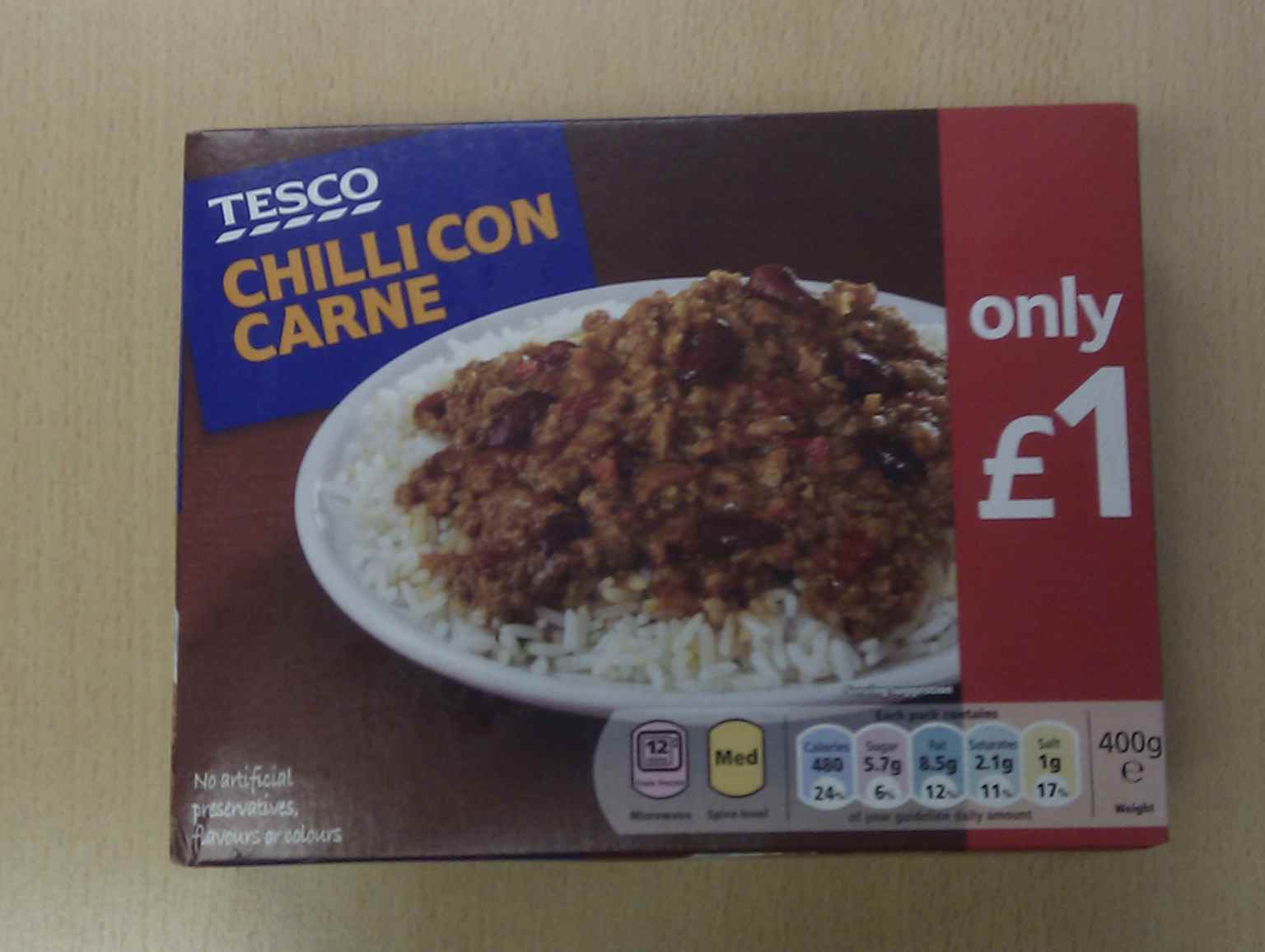
Box fresh - looking good so far.
Lining up against it we have the branded alternative, to whit one can of Stagg Classic chili con carne, plus one pouch of Tilda microwave basmati rice. Pictured below:
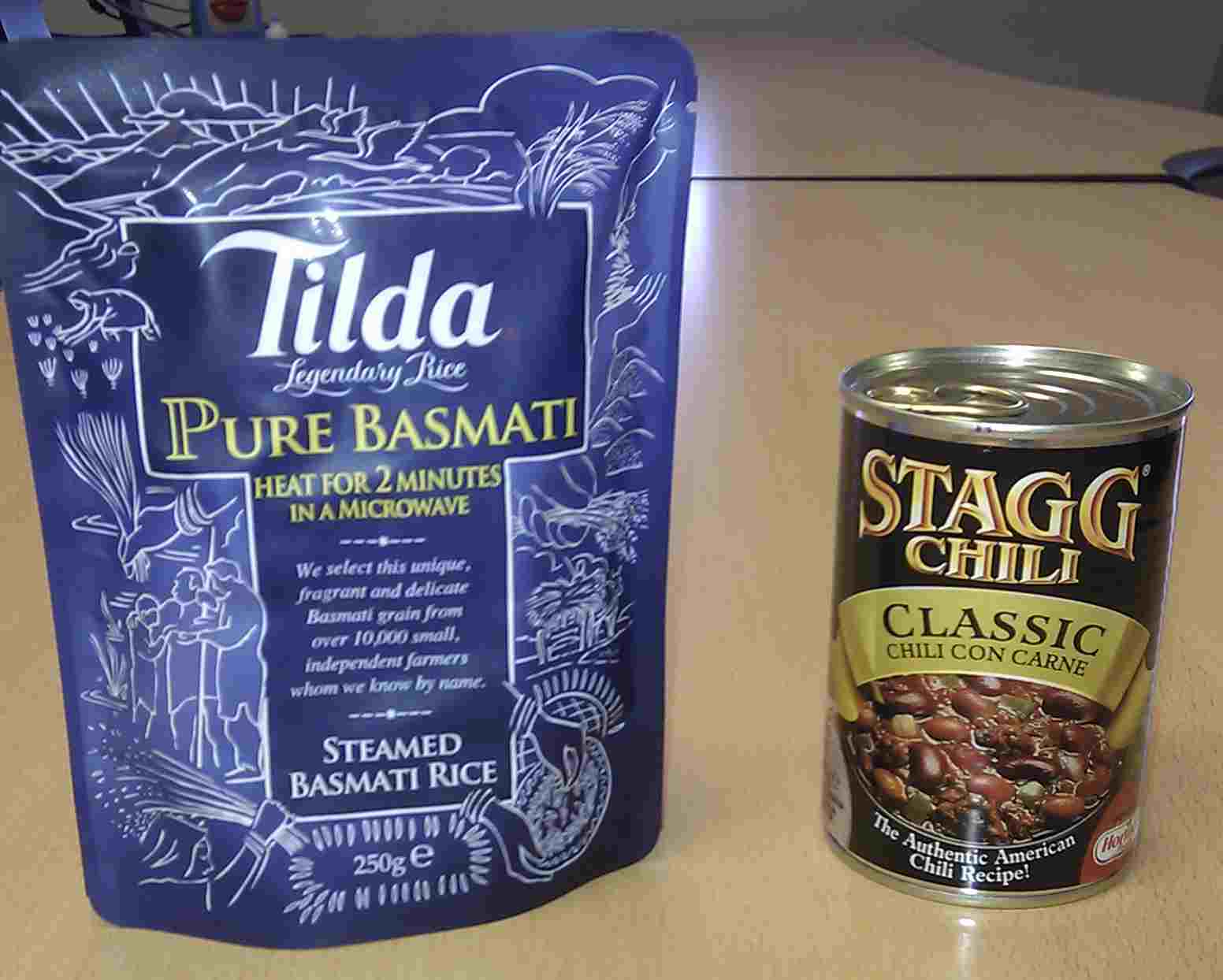
Double team: combined will they be a winner?
Ease of cooking
In the lunch break scenario time is of the essence. Every minute spent in preparing your food is time you can’t spend eating eat or catching up on your personal emails. So how do the two different alternatives stack up. You may have thought that the single package might have had the edge – but you would have been wrong. A total time of 12 minutes is required to heat this meal from frozen. For the canned alternative 2 minutes in a bowl on its own in the microwave, plus another two with its buddy the rice in a pouch next to it was sufficient. This is a definite win for the combo.
Looks and taste
You eat first with your eyes they say and presentation is everything. suffice to say being unceremoniously dumped on a plate is not the best approach for this. I took photos, but not only do they look singularly unappetizing, they are also virtually indistinguishable, so I have not bothered to reproduce them here.
Regarding taste, the Tesco’s frozen effort was distinctly lacking anything approaching heat. Not unpleasant in its way, but by no means great, and by no means chili. The rice was the worst bit. Despite following the instructions to the letter the long grain white rice included had a plastic feel to it. I ate it all, but afterwards I was still hungry, and not particularly impressed.
The branded alternative has the advantage that it does not need to be refrigerated, meaning that if your workplace suffers from fridge-pilfering you can stash it in a lockable filing cabinet or other location. It also tastes quite good. This is of course a relative judgment. It is not as good as homemade, but it is streets ahead of the frozen meal. The addition of pinto beans adds variety to the texture and sets it in a class above its rival. There is even a hint of the spicy to the taste. The rice was really quite good.
Nutrition and Value for Money
I’m putting these two categories together, because they are definitely related.
The frozen meal had a weight of 400g, 480 kcal and 25.3 g of protein and 5.9 g of fibre. This was accompanied by a total of 1.4g of salt, which is pretty high. At a cost of £1 the price was right, but it was not enough to satisfy my appetite – effectively for this to count as a real meal it would need to be doubled up.
The canned chili and the rice that went with it, were, to be fair, sold as containing two portions. I ate it all, because that’s how I roll. 250g of rice and 400g of chili contained a total of 840 kcal, 38.8 g protein and 18.8 g fibre. This comes with a combined 1g of salt – meaning that regarding this it is the healthier of the two options. The cost was £1 for the rice and £1.64 for the can of chili. This equates to a cost of 0.31 pence per calorie compared to 0.20 pence per calorie for the frozen alternative – this makes the Tesco frozen meal the best option financially, but for me the taste of the canned chili, and the quality of the rice, was so much better as to make it worth the extra cost.